
Changing hydrological droughts in southern Quebec in the face of climate change
This project aims to get an overall view of hydrological drought episodes in southern Quebec in the context climate change by better identifying the meteorological conditions leading to such events and analyzing their prevalence in future climates. The project could pave the way for a hydrological forecast adapted to low water levels.
Project details
Principal(s) investigator(s)


Context
In the context of climate change and growing anthropogenic pressures on resources, southern Quebec could experience increased and more marked risks of hydrological drought than in the past. A hydrological drought refers to surface water or groundwater levels dropping well below the long-term average.
These droughts will modify the availability of water for drinking water supply, for ecosystems and for several sectors of socio-economic activity. Understanding the meteorological determinants of hydrological droughts and examining the prevalence of such conditions in the future appears to be a priority for maintaining the security of the water supply sources of several regions of Quebec, in addition to promoting our society’s adaptation to the consequences of climate change.
Objective(s)
The aim of this project is to understand the meteorological conditions that trigger hydrological and hydrogeological droughts and to examine their prevalence in future climates. The specific objectives are to:
Describe the hydrological and hydrogeological drought episodes that have historically occurred in southern Quebec
Describe the weather conditions that have given rise to these droughts in the past
Quantify the prevalence of these conditions in a future climate
Methodology
Hydrological and hydrogeological droughts were detected using the Standardized Streamflow Index (SSI) and the Standardized Groundwater Index (SGI), calculated from historical series from 6718 river sections and 66 wells in southern Quebec. These indices make it possible to quantify the duration, severity, intensity, seasonality and spatial extent of droughts.
The influence of rain, snow and evapotranspiration on the onset of droughts was assessed using standardized weather indices. A predictive model was then used to estimate the probability and severity of the conversion of dry weather conditions into hydrological droughts.
The weather indices were projected as far as 2100 based on CMIP6 climate scenarios (SSP2-4.5 and SSP3-7.0) to assess future changes in the conditions that are conducive to hydrological droughts in a context of increasing emissions and energy consumption.
Results
The analysis of the historical data revealed high spatial and temporal variability in hydrological droughts, with some events remaining localized, while others affected almost an entire watershed. Therefore, a sufficiently dense monitoring network or a spatialized dataset is needed for reliable detection of hydrological droughts. Hydrogeological droughts proved to be more synchronized, especially during major episodes, such as the one in 2021.
Snow plays a central role in the onset of hydrological droughts, as more than half of historical droughts are related to snow accumulation and snowmelt. This proportion increases substantially in the spring (Figure 1). Standardized weather indices incorporating both snowmelt and evapotranspiration showed the strongest correlations with flows and effectively replicated the conversion of dry periods into hydrological droughts. A weak correlation between the standardized weather and hydrogeological indices was observed.
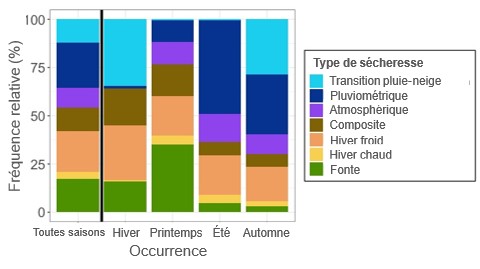
Figure 1. Distribution of hydrological drought types for events recorded in the 109 watersheds of southern Quebec between 1970 and 2022. Rain-related droughts are categorized as a rain-snow transition drought, atmospheric drought, or drought due to rainfall deficit. Snow-related droughts are categorized as a melt drought, warm winter drought, cold winter drought, or composite drought.
The climate projections indicated a paradoxical future. Although average conditions tend towards an increase in total precipitation on an annual scale, the trends vary considerably by season. Indices incorporating snowmelt project significantly drier conditions in the spring, while those considering evapotranspiration suggest summer drying. These divergences underline how different hydrological processes will dominate depending on the season, requiring differentiated adaptation strategies. On the other hand, meteorological droughts will be shorter, but more frequent and more intense, particularly in spring and summer (Figure 2).
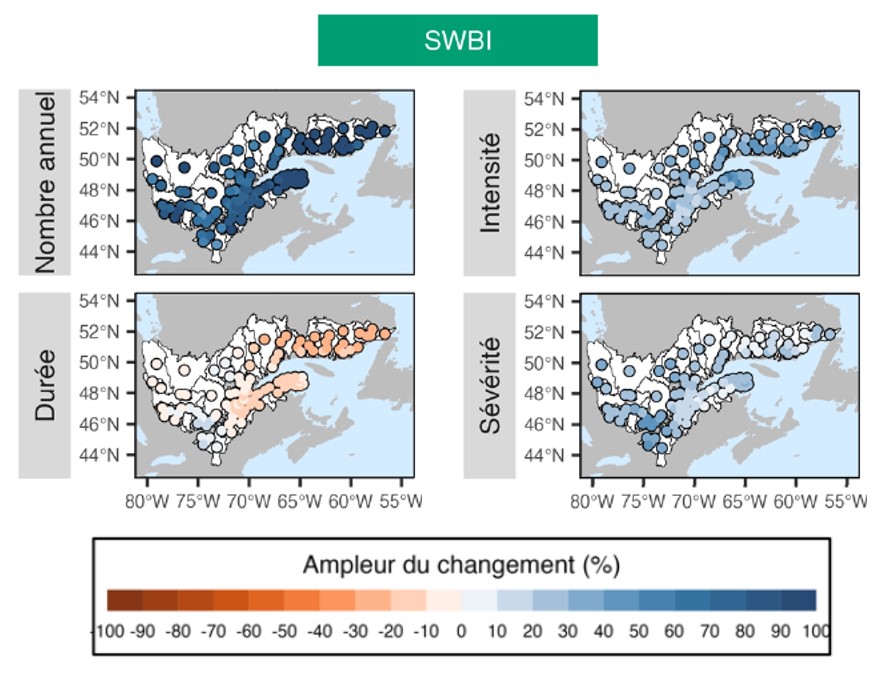
Figure 2. Relative changes between the “distant future” period (2070-2100) and the reference period (1970-2020) in drought characteristics by watershed, based on the Standardized Water Budget Index (SWBI), which is the difference between inputs (liquid precipitation and snowmelt) and losses (potential evaporation), under the SSP3-7.0 scenario. Thus, a relative change of 10% means that in the future period, droughts are 10% more severe than in the reference period.
Benefits for adaptation
Benefits for adaptation
This project confirms the importance of having a sufficiently dense monitoring network, which is necessary for the reliable detection of hydrological drought events.
The statistical model developed with this project could form the basis of a forecasting system capable of estimating the probability and severity of hydrological droughts based on a standardized weather index considering snowmelt and evapotranspiration, thus facilitating more effective water resource management planning.
Scientific publications
Funding


Related projects
710800
