
Snow cover
Climate projections indicate that over the coming decades, winters in North America and Canada will gradually change, with higher temperatures and a reduction in the length of the season.
In Canada, it is very likely that snow cover will decrease until mid-century.
According to an American study published in the journal Nature in January 2024, the decline in the thickness of the snowpack, which will continue and accelerate across Canada, is attributable to human activity. The study shows that climate change has altered the spring snowpack in 31 major river basins in the Northern Hemisphere, including the St. Lawrence and the Great Lakes.
Snow drought: An emerging hazard to be considered
More and more research is focusing on snow droughts, i.e. periods of record low, below-normal snowfall.
Snow droughts are seen as a sign of global warming, and represent a major threat to society and the environment due to their impact on the warmer seasons. With global warming, they are likely to become more frequent and more intense, which will probably increase the frequency of subsequent hydrological droughts.
Projected changes in Quebec
By the end of the century, it is also projected that the SWEmax could increase by 3 to 15% in the extreme north of Quebec, while decreasing by 3 to 28% in the south of the province (Maximum surface snow - portraits.ouranos.ca). It is expected to remain constant in the rest of Quebec. However, uncertainties about the direction and amplitude of change are higher in central and northern Quebec than in the south. For Quebec as a whole, the SWEmax is projected to decrease by 7 to 18 mm (Table 1).
For the province as a whole, the number of days without snow on the ground could increase by 17 to 25 days under the moderate emissions scenario (Table 1).
No change in the spatial distribution of the number of snow-free days across the province is expected. Southern Quebec will remain the region with the most days without snow on the ground, and Nunavik and the Torngat Mountains are expected to remain the regions with the fewest days without snow on the ground (Number of days without snow on the ground - portraits.ouranos.ca).
Climate projections indicate that the duration of snow cover could decrease by more than two weeks across Quebec by the end of the century under the moderate scenario (Continuous snow cover season duration - portraits.ouranos.ca). This reduction is due to both the later start and the earlier melting (Table 1).
| Indicators | Snow cover season (days) | Maximum amount of snow (SWE) (mm) | Nomber of days without snow on the ground (days) | ||
| Duration | Start | End | |||
| Quebec | -16 to -25 | +8 to +13 | - 10 to - 12 | - 18 to - 7 | +17 to +25 |
Table 1 : Anticipated change in snowpack in Quebec by the end of the century under the moderate emissions scenario (compilation of the three indicators provided on Portraits.ouranos.ca)
Initiated by the Quebec Ski Area Association (the ASSQ), this project led to the following conclusions on changes in snow cover in Quebec’s ski region, where the majority of its alpine ski resorts are located:
A reduction in the length of the snow season, with a late start and an early end, and an increase in the number of days without snow cover
A decrease in maximum SWE, greater in the south and on the plains than in the mountain ranges
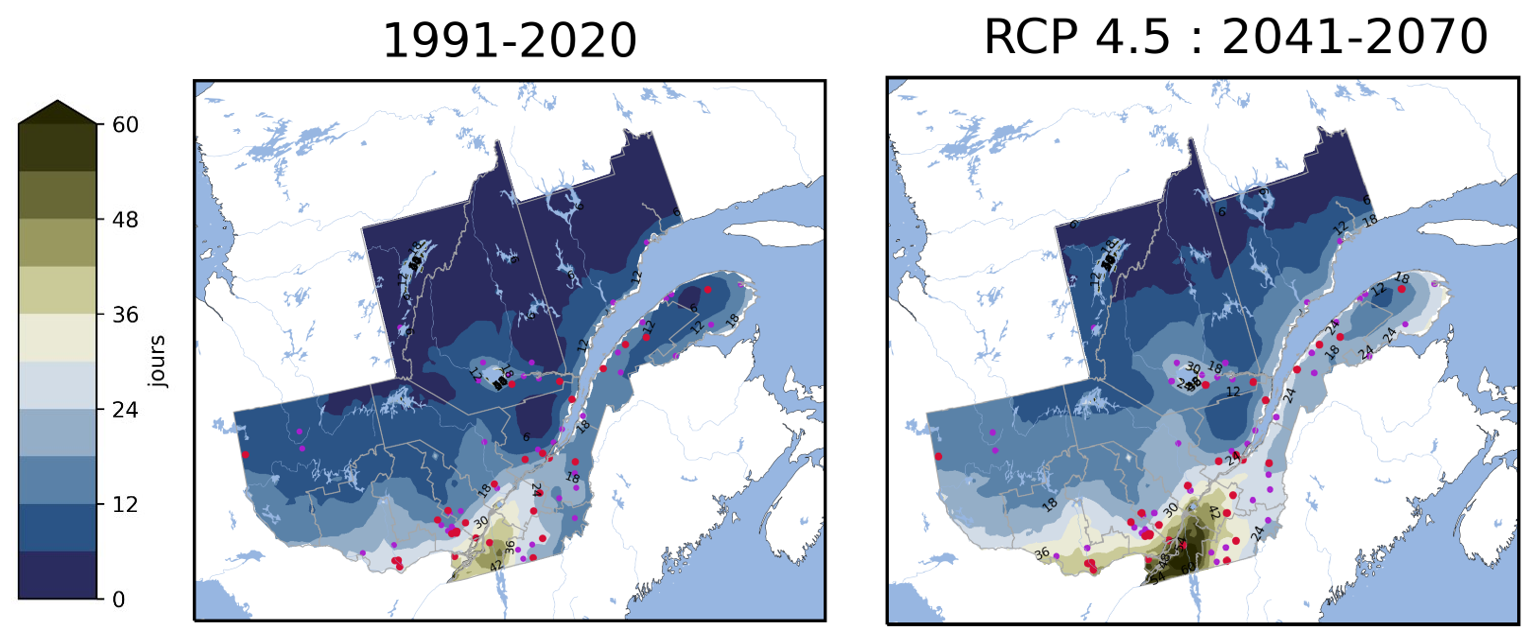
Figure 5: Number of days without natural snow cover in Quebec’s alpine ski region between November and March (Bresson et al., 2024). The points correspond to ASSQ-affiliated ski resorts.
The data was produced for the whole of Quebec and made public, facilitating access to historical and future climate data on snow on the ground over the whole of Quebec at an approximately 10 km resolution.
Users and decision-makers in many sectors now have a wider range of climate information to use in their adaptation plans.
Last update of the page : February 2026.
