
Quebec is known for its harsh winters, snowy landscapes and iconic winter activities. But due to climate change, these seasonal traditions are changing rapidly. The winter, as well as the transitional seasons of autumn and spring, will change over the next few decades. Temperatures, precipitation and snow cover will stop following old patterns, with major impacts on infrastructure, the economy and leisure activities.
Rising temperatures
Winters have already warmed by 0.3 to 0.5 °C per decade in Quebec, and this trend will continue in the future. According to climate projections, the average winter temperature in the province is expected to rise by about 6.6 °C by the end of the century compared to the period from 1991 to 2020, with more pronounced warming in the north.
This increase will result in milder and wetter winters, shorter seasons with snow cover, and a seasonal shift in freeze-thaw cycles.
According to a study in the Journal of Applied Meteorology and Climatology, daily freeze-thaw events will become more frequent in the winter but will decrease in fall and spring.
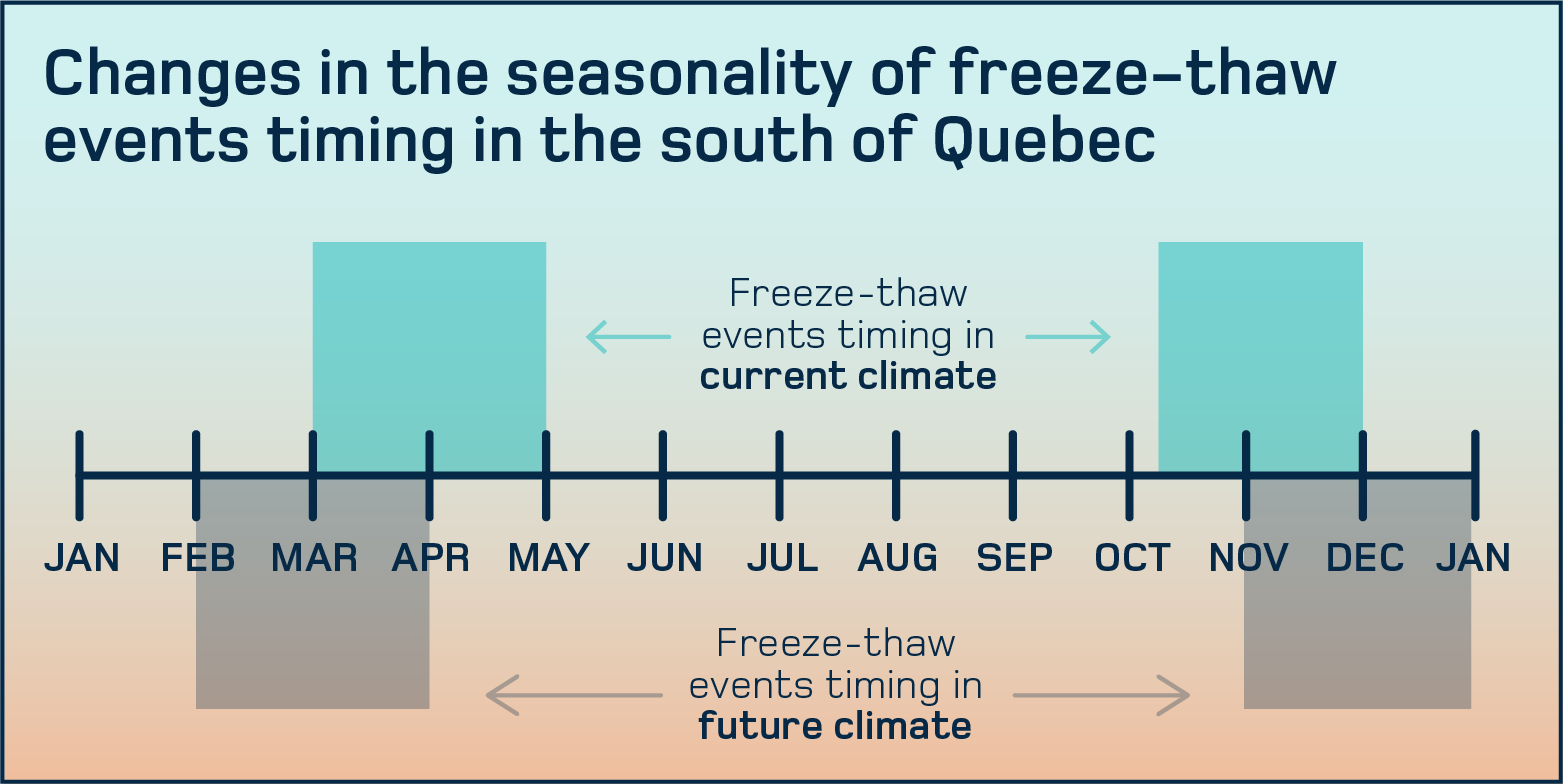
A daily freeze-thaw event occurs when the minimum temperature is below 0 °C and the maximum temperature is above 0 °C in the same day.
Although our winters are changing, this season remains naturally variable, meaning that it can be very different from one year to the next. There will always be colder-than-normal winters. However, in the future, abnormally cold winters will be warmer than those experienced so far. This also implies that cold records will be harder to beat.
Precipitation: More rain, but plenty of snowstorms
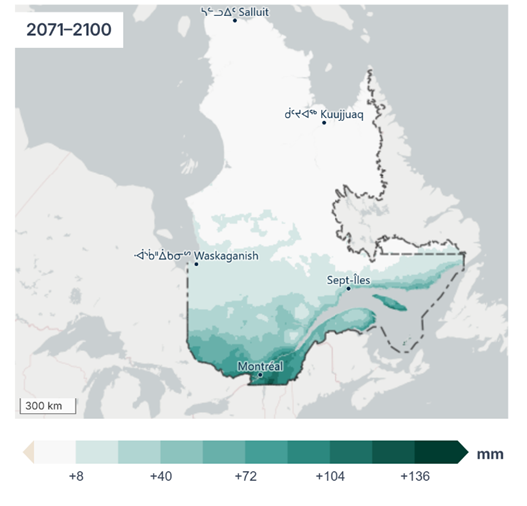
Across the province, projections indicate an increase in precipitation during the winter. In more northern regions, this increase will mainly take the form of snow, while in the south, a larger proportion of this precipitation will fall as rain.
That said, a study published in the Journal of Geophysical Research shows that although average snowfall is expected to decrease in the southernmost regions of Quebec, snowstorms will continue to occur there. A warmer atmosphere retains more moisture, which, during colder winters, can promote snowfall as intense as or even more intense than today.
Fig: Change in winter liquid precipitation by 2071-2100 compared to 1991-2020 (SSP 3-7.0) Climate Portraits, Ouranos, 2025.
Freezing rain is well-known in Quebec. The province is one of the places most affected by this type of event in North America. Climate change is putting Quebec in a transition zone: in the north and northeast of the province (with the exception of coastal regions), an increase in the median number of hours of freezing rain is expected, while a decrease is anticipated in the more southern regions. In other words: more freezing rain is forecast for the north and northeast, but less for the south.
Go to Climate Portraits to explore different winter precipitation indicators.
Snow cover declining in southern Quebec
While snowstorms will continue to occur, snow cover is tending to decrease in the southern part of the province. Milder temperatures and winter rain will increasingly cause it to melt.
A study on snow cover indices (PINS, Ouranos 2024) confirms a decrease in snow water equivalent (SWE) particularly in southern Quebec and the St. Lawrence Valley. For example, the annual maximum SWE could decrease from 145 mm to 120 mm in the southwest of the province.
Snow water equivalent (SWE): The amount of water in liquid and solid form present in a snowpack, obtained by melting all the snow in a sample collected at a weather station.
However, the trend is less clear for regions in the centre of the province such as Jamésie and northern parts of Côte-Nord. In Nunavik, a slight increase in the annual maximum snow cover is projected.
In addition to decreasing in quantity in many regions, the snow cover will be shorter in duration all over Quebec. The season with snow on the ground may be shortened by two to four weeks in Quebec. According to the PINS report, continuous snow cover will decrease from approximately 140 to 115 days to the southeast of the St. Lawrence Valley, and from 210 to 190 days in regions such as Saguenay and Côte-Nord. Mountainous regions, such as Gaspésie and Charlevoix, will remain snowier, but will also have a shorter period of snow cover.
To learn more, visit
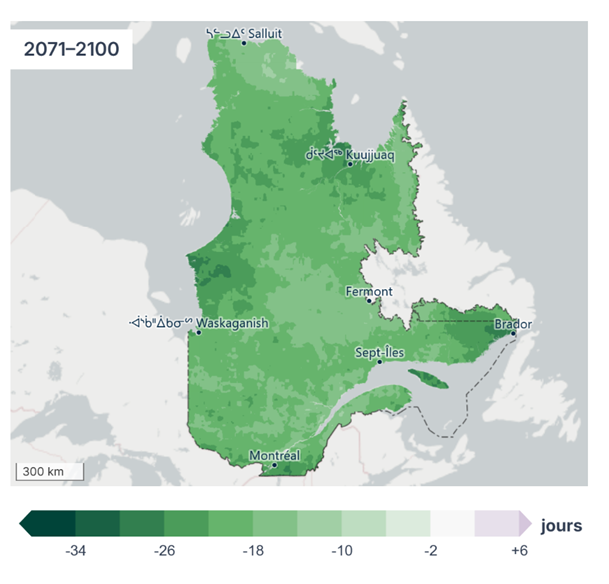
Fig: Change in annual duration of continuous snow cover by 2071-2100 compared to 1991-2020 (RCP4.5) Climate Portraits, Ouranos, 2025.
Multiple impacts: Infrastructure, the economy and the environment
While milder winters may seem like good news for those who dislike the cold, the reality is less rosy than one might think. Our land use planning, our ecosystems, our economic activities and our culture have adapted to long, cold, snowy winters.
While not all the impacts of winter changes are yet fully known, we do know, for example, that snow cover is an important thermal insulator for agricultural soil. Thus, its decline could negatively affect certain crops.
Maple syrup production, which depends on stable temperature conditions in the spring, could see its yields decrease and its tapping schedule change.
For ski resorts and winter tourism in general, this reality is worrying. The report entitled “Diagnosis of the Quebec Ski System’s Vulnerability to Climate Change” (Ouranos, 2024) highlights the growing dependence on artificial snow, leading to higher energy and water costs.
Indigenous communities will also see their way of life affected, particularly hunting and fishing. Travel on winter roads—essential in northern areas—will also become less reliable and could pose safety challenges.
Quebec will not lose its winters, but they will be shorter and milder. Snowstorms will continue, but rain will gain ground. These changes require rapid, concerted adaptation to preserve safety, the economy and the winter culture that is part of Quebec’s identity.
