
Freeze-thaw events
Across Quebec, projections indicate that climate change will cause a shift in the time period during which freeze-thaw events will occur.
The increase in average temperatures can cause variations in the period during which temperatures are amenable to freeze-thaw cycles. According to a study published in the Journal of Applied Meteorology and Climatology, daily freeze-thaw events will become more frequent in the winter and will decrease in the fall and spring.
Changes in the seasonality of freeze-thaw events in Quebec’s regions
Based on a high emissions scenario (SSP3-7.0), climate projections indicate that freeze-thaw events will shift in season in all of Quebec’s regions, occurring about two weeks earlier in the spring and two weeks later in the fall by the end of the century.
In northern Quebec, while these events occurred mainly in September-October and May-June in the reference period, they will be seen more in October and May by 2100.
In the southern part of the province, freeze-thaw events are currently most frequent from mid-October to early December and from March to May. However, by 2100, projections indicate that there will be more from December to February. This means that the two freeze-thaw seasons will come closer together in the winter and will gradually tend to become a single freeze-thaw season. In fact, the probability of seeing freeze-thaw days in January will double, from 20% to 40%.
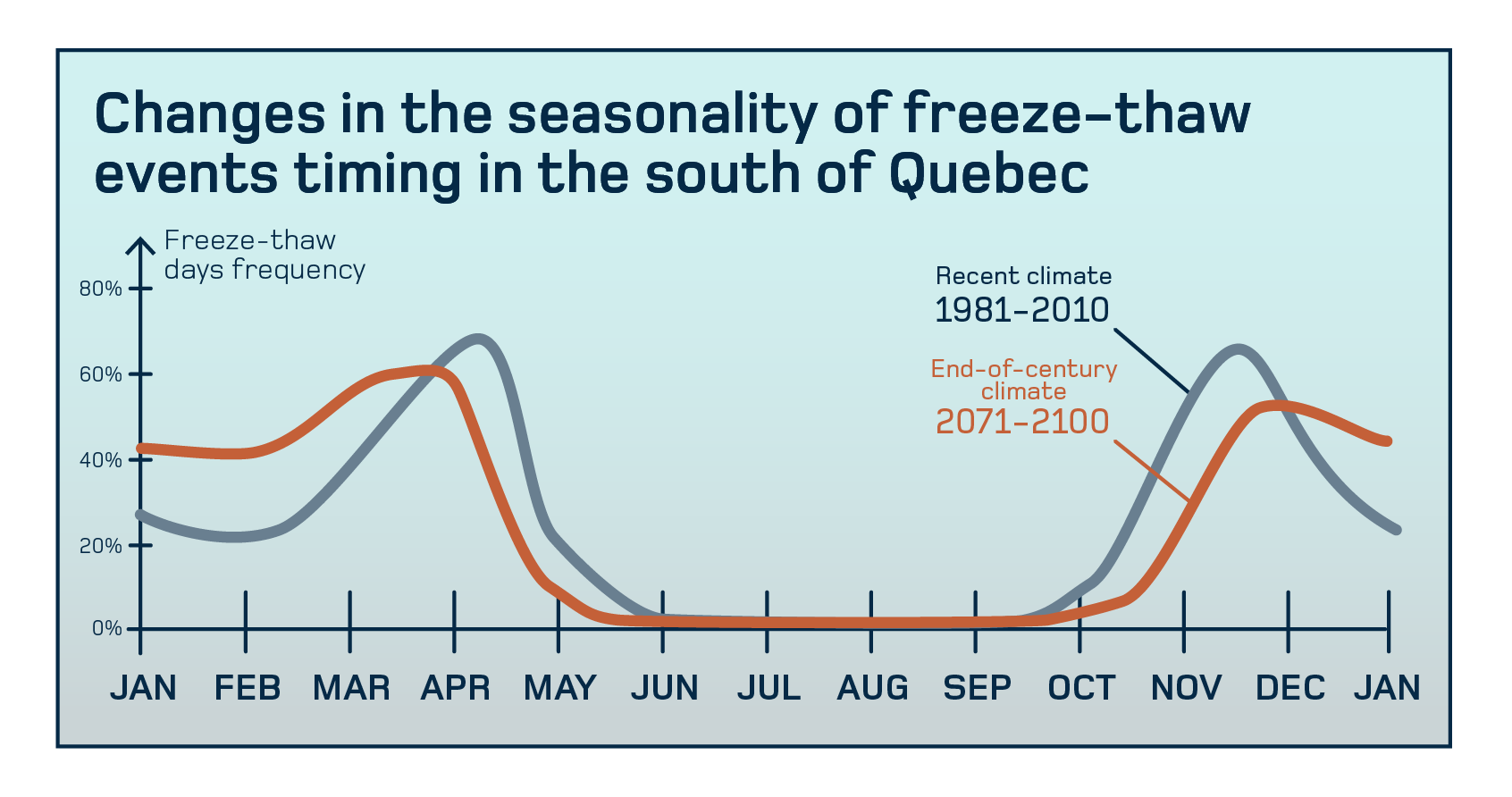
Figure 1: Percentage of years in which a freeze-thaw event occurs for each day of the year, obtained from the ESPO-G6-R2 model for the four regions (NQ, MTL, MIN, and NC), for the periods 1981–2010 (in blue) and 2071–2100 (in gray). The frequency corresponds to the number of freeze-thaw days over 420 model years averaged at the regional scale (adapted from Journal of Applied Meteorology and Climatology 64, 10; 10.1175/JAMC-D-24-0190.1 Fig. 4).
While our winters are changing over time, this season is naturally variable, and can be very different from one year to the next. There will always be colder-than-normal winters. However, future winters, springs and autumns will tend to be warmer and warmer, which will contribute to this seasonal shift.
Although a seasonal shift is expected, the total annual number of freeze-thaw days is expected to remain stable or decrease slightly, depending on the region and future horizon considered.
In the more northerly regions, the total annual number of freeze-thaw days will decrease very slightly, while in the more densely populated regions in the south of the province, the total annual number of freeze-thaw days will remain stable in the future. This is a hazard that we will have to continue coping with in the future.
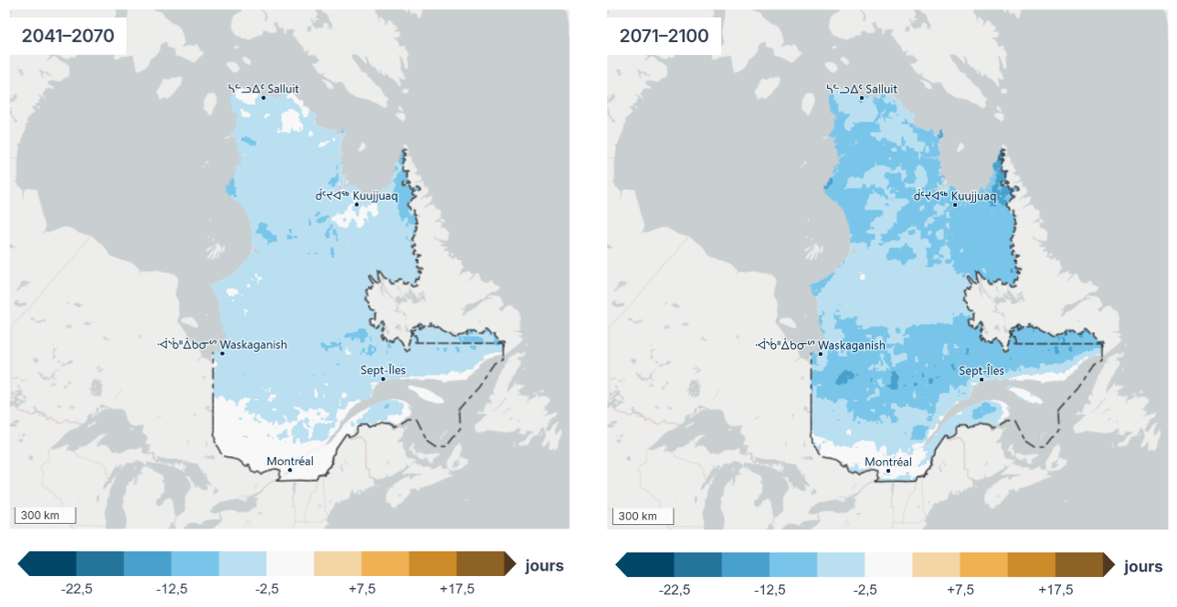
Figure: Anomaly in the number of freeze-thaw days by mid-century (2041-2070 horizon on the left) and by the end of the century (2071-2100 horizon on the right), compared to the historical period of 1991-2020, under a high GHG emissions scenario (SSP3-7.0). Climate Portraits platform, 2026.
Explore the different winter indicators on the Climate Portraits platform
