
Understanding Adaptation Science
Adaptation initiatives in Quebec have grown in number in recent years. They address a number of issues related notably to forestry, mining, energy and agriculture, and concern a range of environments throughout Quebec including northern, maritime, urban and rural settings. Other initiatives also revolve around the eight adaptation priorities identified in Ouranos’s program for 2020-2025.
Dealing with climate risks or implementing adaptation measures
Adaptation measures, also known as adaptation initiatives or solutions to cope with climate risks, can be found in Step 4 of the adaptation process. Risk management involves ranking adaptation measures on the basis of the prioritized list of climate risks drawn up in the risk assessment. It makes it possible to plan the solutions to mitigate the risks, and then to implement them and monitor them.
Other initiatives also revolve around the eight adaptation priorities identified in Ouranos’s program for 2020-2025.
Programming will revolve around eight highly inter-related adaptation priorities while considering social, environmental, economic and built environment dimensions: Quebec’s economy, energy security, water availability, food systems, social and health challenges, extreme events, living environments, governance.
Generally speaking, both in Quebec and around the world, adaptation has often been planned in an “incremental” manner, i.e. by making adjustments while preserving the essence and integrity of a system or process at a given scale. However, faced with the growing magnitude of climate change impacts, the IPCC suggests that we rethink the way we adapt by opting for “transformational” approaches, as opposed to the incremental approaches that have hitherto been the norm. For certain issues in Quebec, this transition seems to be already underway.
For example, in coastal areas, it is no longer envisaged to resort solely to protective structures to address current impacts as well as short-term erosion and coastal flooding risks. Long-term land development is undergoing a rethink, notably with regard to building structures farther inland. In the years to come, it is expected that this transition from incremental measures to transformational measures will continue in order to take better account of the long-term evolution of the climate and its impacts on natural and human systems.
Following several consultations and a cost-benefit analysis conducted by Ouranos on solutions to sustainably protect tourism infrastructure along the coast and in town, a section of beach over 1 km long was redesigned in 2017. The initiative consisted of a new boardwalk and other installations of recreational nature to give the downtown area a “facelift” while preserving, if not improving, the area’s tourist appeal.
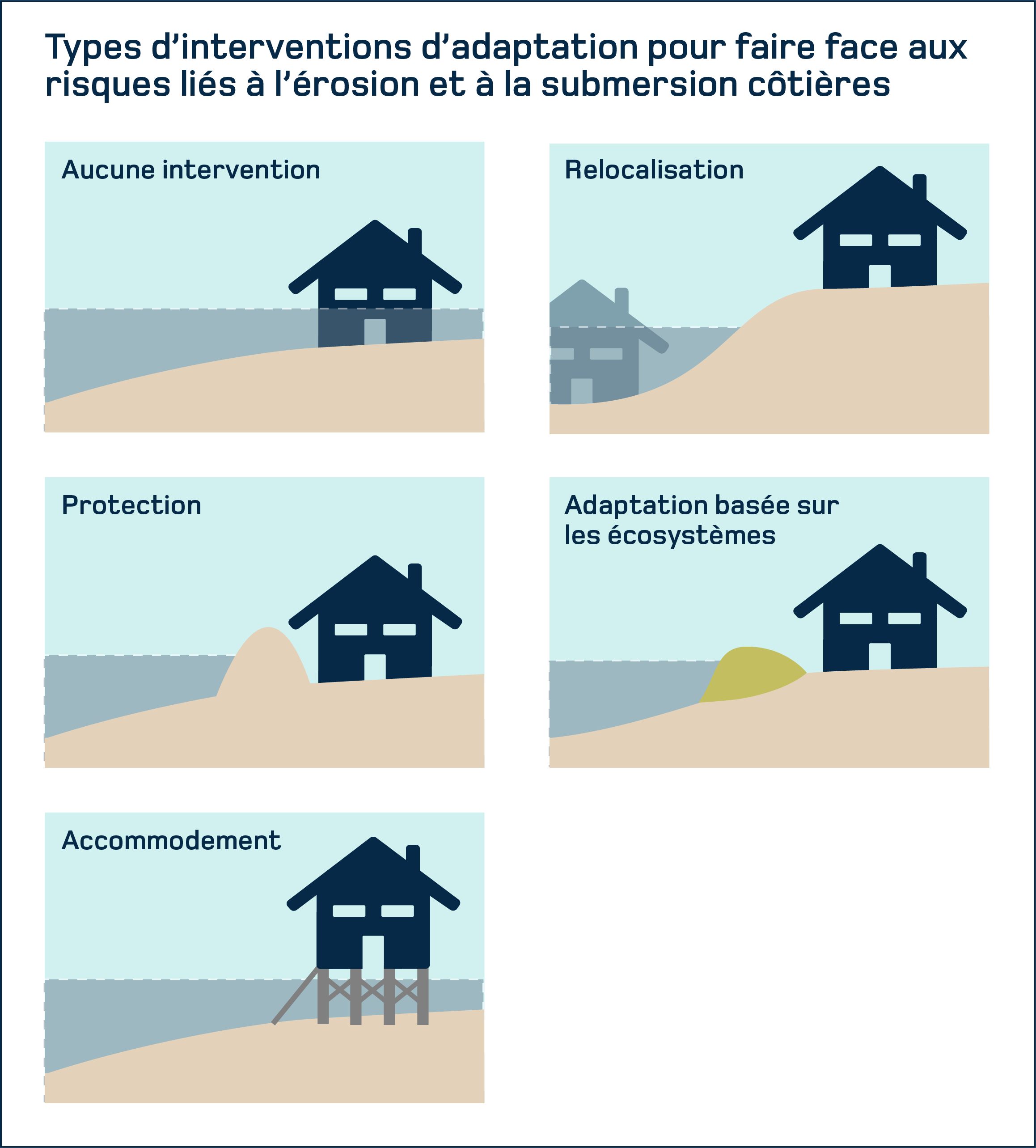
Figure 1 : Types of adaptation measures to address risks related to coastal erosion and flooding. (Inspired from: Auditor General of Quebec, 2023).
Videos by Ouranos
Ouranos offers a series of easy-to-understand videos exploring practical solutions for adapting to climate change (the Finding Solutions series).
