
Understanding Adaptation Science
What is an impact chain?
A climate event can have many consequences: on health, the economy, the environment, etc. (known as systems).
An impact chain is a chain of multiple effects.
It represents the cascade of consequences associated with one or more climate hazards. It is a useful way of understanding the causes of impacts.
When presented as a diagram, it illustrates the origins of direct and indirect impacts and their propagation through the various interrelated systems. Visualizing cause-and-effect relationships between hazards and systems has the advantage of highlighting unexpected indirect impacts in the middle or at the end of the chain.
IPCC definition
Cascading impacts: Cascading impacts from extreme weather/climate events occur when an extreme hazard generates a sequence of secondary events in natural and human systems that result in physical, natural, social or economic disruption, whereby the resulting impact is significantly larger than the initial impact. Cascading impacts are complex and multi-dimensional, and are associated more with the magnitude of vulnerability than with that of the hazard.
Source: IPCC (2023). AR6 Synthesis Report Climate Change 2023, Annex II - Glossary.
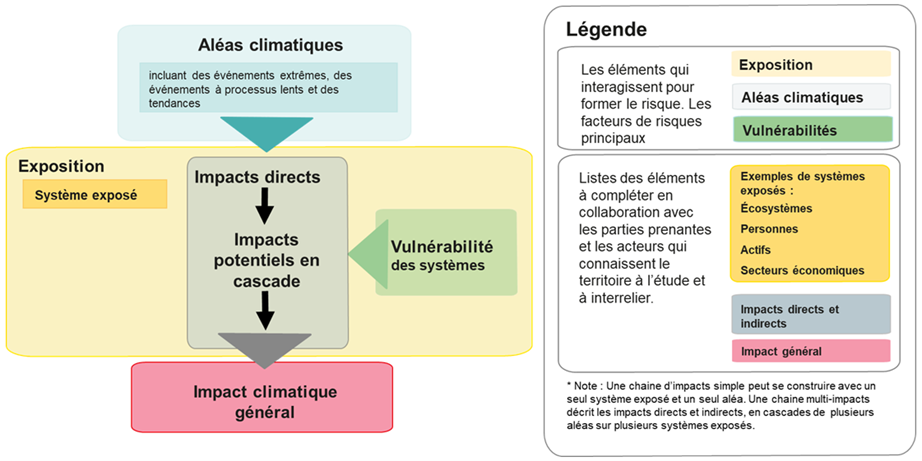
Figure 2: The elements that are the main building components of an impact chain. This figure draws from Zebisch, M. et al. (2023). Climate Risk Sourcebook. Deutsche Gesellschaft für Internationale Zusammenarbeit (GIZ) GmbH. Bonn. https://www.adaptationcommunity.net/climate-risk-assessment-management/climate-risk-sourcebook/
To conceptualize these cascades of impacts, one needs to understand the interactions of local systems first. This makes it possible to identify the direct and indirect impacts of hazards on these systems. For example, an adaptation measure that reduces an impact can interrupt the cascade of consequences like a domino piece being removed from a series of dominoes.
How to build an impact chain
Building an impact chain requires describing the systems exposed to the climate hazard(s) and their interdependencies. The steps involved in building an impact chain are as follows:
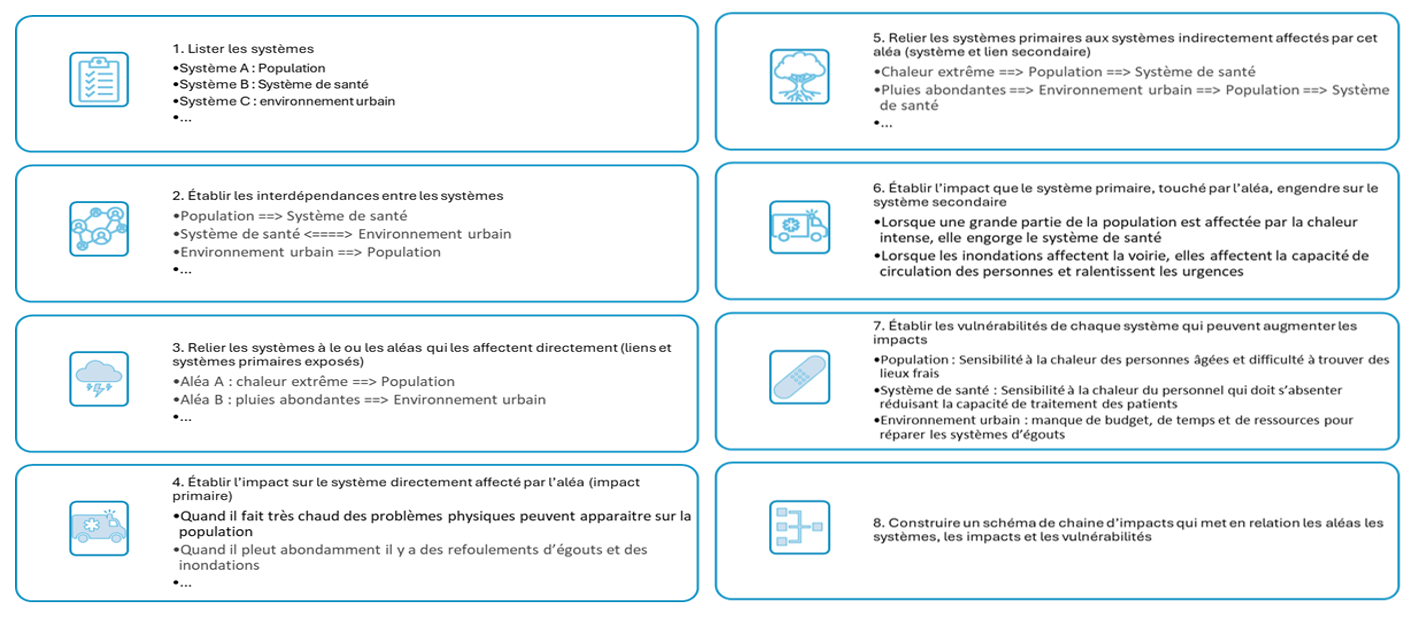
Figure 3: Steps in building an impact chain.
The relationship between hazard and impact is often quite direct and tangible. Floods, for example, cause losses and damage to buildings.
System-specific vulnerabilities can be more difficult to establish, as they are strongly context-dependent and sometimes intangible. For example, a wetland could become vulnerable to heavy rainfall if it becomes degraded—naturally or due to human activity—and its capacity to retain rainwater is reduced.
Involving stakeholders in building impact chains
It is advisable to draw up impact chains with the participation of the stakeholders concerned, and to consider certain adaptation measures with them from the outset. The interdependencies of systems and their interactions with climate hazards will be more evident in collaboration with those who know the systems best.
Once the impact chain has been built, questions can be asked about vulnerability factors such as sensitivity and adaptive capacity in discussions with stakeholders. In these discussions, the adaptation measures that have already been taken are recognized, and others can be identified based on sensitivity factors.
The impact chain is part of the first step in assessing climate risk.
