
Understanding Adaptation Science
How to plan adaptation well
Adaptation is a continuous, iterative process that must take new knowledge and learnings into account. The aim is to reduce the climate risks to a system, thereby achieving or maintaining its climate resilience. The adaptation process leads to the implementation of adaptation measures that are prioritized based on the systems that are most at risk, and to the establishment of indicators for evaluating and monitoring these measures.
Definition | System
A system is a set of elements that are considered in terms of their relationships within a whole that functions as a unit. A system is made up of various components.
Systems | Componants |
Road network | Traffic lanes |
Bridges, culverts, tunnels | |
Buildings | Foundations |
Outdoor envelope | |
Roofing | |
Population | Residents |
Municipal workers |
Table 1: Examples of systems and their associated components.
The adaptation process should give rise to a comprehensive, integrated understanding of the issues, since there are many of them and they may be interrelated. It is a cross-cutting, structured process that enables support for all the sectors affected. It also optimizes the financial, material and human resources expended.
Steps in the adaptation process
The adaptation process consists of several steps that can be presented in different ways. The process shown below has five main steps, preceded by the conditions that are essential to its success.
This approach is based on the guide Élaborer un plan d’adaptation aux changements climatiques – Guide pour les organismes municipaux (French only).
The conditions for success
For an adaptation process to be effective:
The governance of the process must allow organizations to adapt proactively by taking on several roles in adapting to climate change.
The adaptation process should be coordinated with other related processes to ensure consistency and efficiency.
The principle of equity must be integrated into the adaptation approach and be applied throughout the process.
Getting all relevant parties involved enables the inclusion of a variety of transversal issues throughout the process.
The availability of financial, human and material resources influences the actions that can be taken.
Step 1 is to identify the parties responsible for leading the adaptation process that will culminate in an adaptation plan. During this stage, experts who can provide support are identified.
Step 2 is crucial, as it defines the objectives of the plan, the scope of the action, and the profile of the area or organization. This includes the systems, hazards and impacts to be taken into account in the various analyses, climate data, and risk analysis scales.
In Step 3, current and future climate risks are identified and ranked in order to prioritize the adaptation measures to be taken.
Step 4 aims to identify the adaptation measures needed to manage the risks, based on the prioritized list resulting from Step 3. At this stage, a timetable for the implementation of the measures, the required resources, and the indicators to monitor should be established. Lastly, follow-up measures and monitoring indicators must be implemented.
Step 5 is to produce and disseminate the adaptation plan, and to monitor and evaluate the measures in order to assess their effectiveness. Once monitoring has been completed for this first iteration of the adaptation process, the measures and the approach are adjusted in accordance with the results.
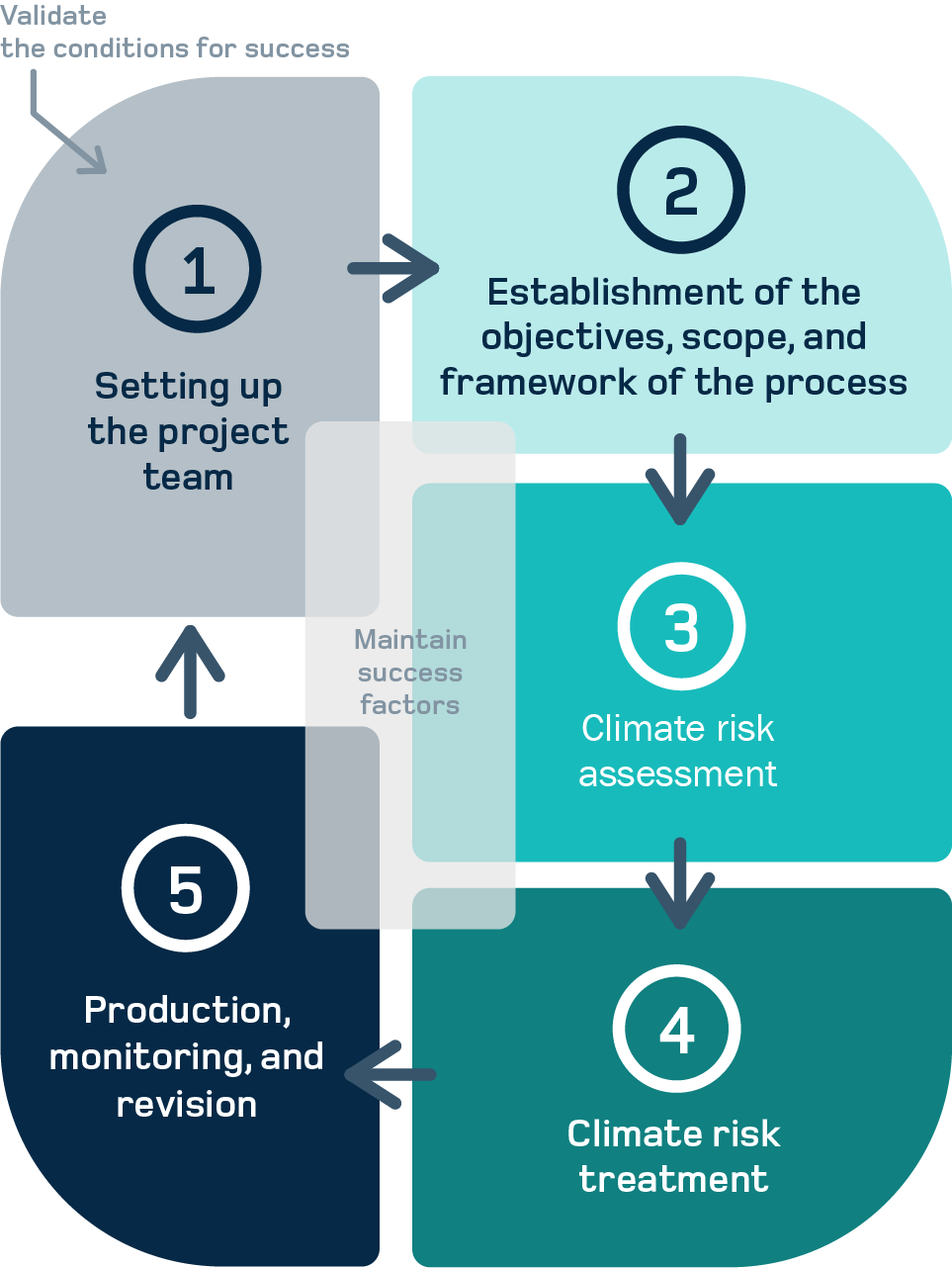
Figure 1: The steps in the adaptation process
Avoiding Maladaptation
Maladaptation can occur when adaptation measures exacerbate rather than mitigate the impacts of climate hazards. For example, riprap or a protective wall may be installed on coastal land to adapt to increasing coastal hazards, but in some cases, this can worsen erosion on adjacent land. So, while the land on which the riprap has been installed is protected, the neighbouring land sees its vulnerability increase.
To avoid maladaptation, there are a number of factors to consider when choosing an adaptation measure.
Consider a spatial scale larger than that of the system to be protected to ensure that no neighbour is adversely affected.
Consider a longer time scale to check whether the measure becomes negative over the long term.
Climate issues should be assessed in a transversal manner. Due to the interdependence of human, ecological, socio-economic and built systems, a climate hazard generally affects several sectors of society. One affected sector can in turn disrupt another, and so on. Impacts then propagate in what are known as impact chains.
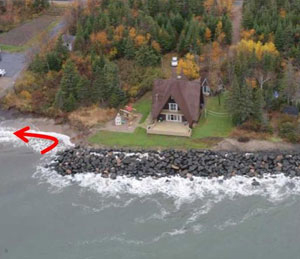
When waves pound a retaining wall or riprap, their energy is redirected to the structure’s extremities, which can accelerate erosion of the adjacent shoreline. This is referred to as the flanking effect. Source: Ministère de la sécurité publique du Québec
The Ministère de l’Environnement, de la Lutte contre les changements climatiques, de la Faune et des Parcs partnered with Ouranos to produce the guide, Climate change adaptation planning - A guide for municipal bodies.
The guide aims to facilitate the development of the adaptation component of Quebec's municipalities climate plans.
