
Special dossier : Tourism Industry
Faced with multiple and growing climate impacts, the tourism industry must address a number of challenges to maintain :
The quality of tourism offerings over the long term, despite more variable weather conditions and rising adaptation costs;
The long-term viability of infrastructure, equipment, and facilities that are exposed to weather events, while minimizing the impact on the natural environment;
The health, safety, and well-being of customers and employees despite the increase in extreme weather events.
Action needs to be taken promptly so that the tourism industry can address the challenges of climate change and even capitalize on the opportunities it present.
TAKING ACTION PAYS OFF
Every dollar invested in adaptation can generate $13 to $15 in long-term benefits.
Sawyer et al., 2022
Climate change is putting the tourism industry to the test
Quebec offers a wide variety of activities and attractions throughout the province. Some of them are particularly vulnerable to climate change and may be affected in different ways depending on their specific characteristics.
Explore the opportunities that have been identified in response to specific threats
A variety of complementary actions
No single measure can, on its own, address all the challenges posed by climate change.That’s why adaptation is based on a set of complementary measures that can generate a wide range of positive benefits, particularly in terms of public health and safety, environmental conservation and infrastructure resilience, and that also contribute to the prosperity of communities.
Understanding the categories of measure
Any physical structure designed to reduce or prevent the potential impacts of hazards, or the implementation of engineering measures to ensure that structures or systems are resistant to hazards and are resilient.
Construction of a flood control structure
Creating “cooling islands”
Nature restoration
Any measure that does not involve construction and that draws on knowledge and best practices for reducing risks and impacts, particularly through policies and laws, public awareness campaigns, training and education.
Raising customer awareness of the impacts of climate change
Expanding the range of activities available year-round
Organizing a workshop on climate change adaptation for businesses
Drawing inspiration from successful initiatives
Designed as a source of inspiration, this catalogue lists climate change adaptation measures implemented at various scales, in Quebec and internationally.
It describes 35 grassroots initiatives, 15 of which were analyzed in depth, all based on work conducted by Touriscope. Selected for their relevance and potential transferability, these measures offer practical ways to help tourism organizations strengthen the resilience of their operations.
This accessible, easy-to-understand catalogue allows users to explore inspiring examples and learn about adaptation solutions. It can inform the strategic thinking of Quebec’s tourism organizations.
A strategic plan for action
Climate change adaptation is a shared responsibility. It requires a cross-cutting, multidisciplinary approach. The wide range of possible adaptation solutions can make decision-making difficult, which is why strategic planning is essential in order to effectively identify and prioritize actions and the stakeholders to be consulted.
Planning makes it possible to define a long-term vision, identify high-priority issues, and establish the strategic directions and objectives that will guide actions over the coming years. The preparation process translates these strategic directions and objectives into concrete actions.
Without a strategy, there is a risk of actions being scattered and inconsistent. Without an action plan, the strategy remains theoretical and does not generate concrete results. Together, they ensure a structured, consistent, goal-oriented approach to achieving an organization’s objectives.
A constantly evolving strategic approach
This strategic planning within the organization must also be part of a broader adaptation process that advances in step with new knowledge on climate change and the experience gained by the organization. This makes it possible to adapt practices, reduce risks, and take proactive measures to address the climate realities of today and tomorrow rather than simply reacting to them.
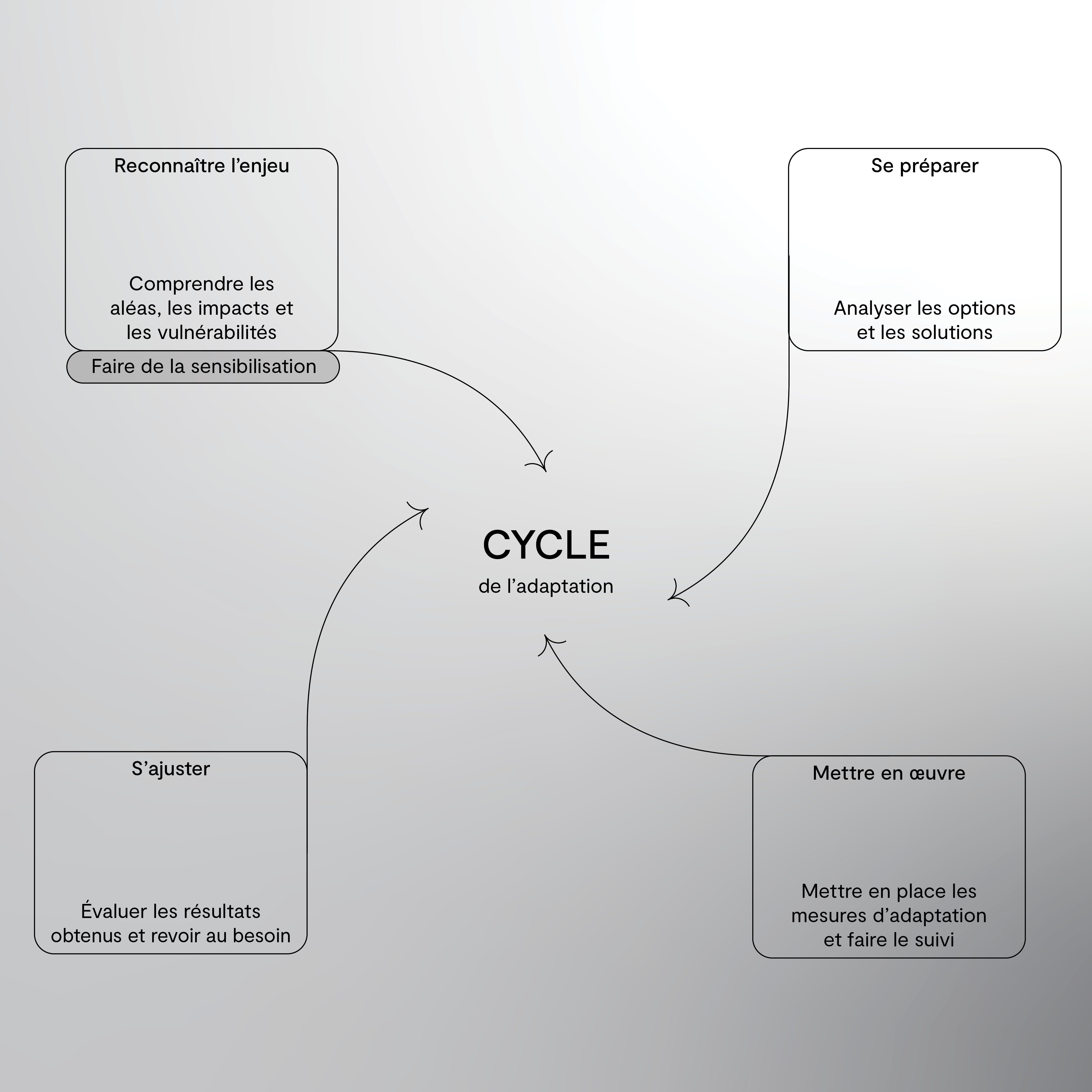
Looking at the conditions for success
To effectively implement a climate change adaptation strategy, it must be based on certain key factors. These help to structure the work, ensure the initiatives are more consistent, and increase their impact over time.
By using climate data platforms (e.g., Climate Profiles) to track projections, you base your decisions on rigorous, up-to-date scientific information.
Example
A tourism association consulting the Climate Portraits climate data interface to assess the climate change vulnerability in its region or sector.
By coordinating your efforts with those of other stakeholders (municipality, agriculture sector, public health, etc.), you promote collaborative action and avoid working in silos.
Example
A tourism association participating in stakeholder engagement activities organized by an RCM to develop a climate action plan.
By participating in networking groups (communities of practice, innovation teams, co-development cohorts), you can share insights and foster the development of solutions that are in keeping with the real-world conditions.
By pooling financial, human, and material resources, you can avoid duplicating efforts and increase the effectiveness of collective initiatives.
Example
A tourism association getting regional organizations involved in supporting a business that is implementing climate change adaptation solutions.
By involving the communities, economic sectors, and businesses that are most vulnerable to current and future climate events, you ensure that the costs and benefits are fairly distributed, while taking social, economic, and environmental impacts into account.
Example
A tourism association providing financial support to businesses facing major, unforeseen climate-related challenges that cause unexpected financial losses.
By integrating climate change adaptation into your existing planning and management methods, you strengthen your long-term vision and promote consistency in the actions taken across the organization.
By providing opportunities for dialogue and input, you strengthen stakeholders’ sense of belonging and their commitment to implementing initiatives.
Example
A sector-specific regional tourism association organizing a workshop on climate change adaptation for all its members.
Explore other resources
Explore practical adaptation solutions for three specific climate-related events: wildfires, extreme heat, and flash floods.
Explorez les projets de recherche menés par Ouranos pour accompagner l’industrie touristique face aux enjeux climatiques.
Read two interviews with Quebec tourism stakeholders conducted in 2019.
Knowledge, tools, and resources were developed in collaboration with tourism industry stakeholders under a mandate given to Ouranos by Quebec’s tourism ministry to
