
International Network of Boundary Organizations on Adaptation
Context
" Adaptation implementation is progressing, but gaps remain. " — United Nations Environment Programme (UNEP) 2025 Adaptation Gap Report
Even if carbon emission reduction commitments for 2050 are met, the climate is changing and will continue to change in the coming decades. That make adaptation an imperative.
Despite some progress, climate change adaptation efforts remain fragmented, marginal, sector-specific, and variable from one region to another. A gap remains between those with scientific and technical experts and the people who are responsible for designing adaptation plans, policies, and programs.
According to Simon Stiell, Executive Secretary of the United Nations Framework Convention on Climate Change, we have now entered the implementation phase, which calls for concrete action. However, such action is inconceivable without reliable data, without factual information to inform decision-making, and without the scientific foundations essential for developing public programs and policies.
Boundary organizations can be a means to close this adaptation gap.
What is a boundary organization?
" Organizations that specifically and actively facilitate the process of enabling exchange between the production and use of knowledge to support evidence-informed decision-making in a specific context. " — Bednarek et al., 2018
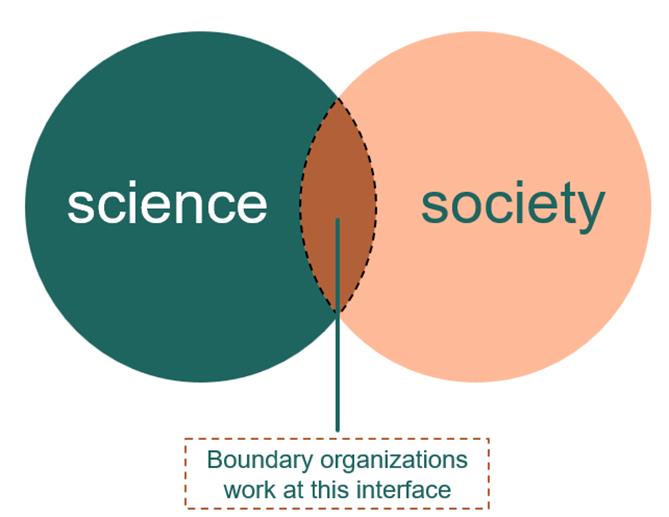
Definition
Boundary organizations connect scientists and decision-makers, along with professionals who facilitate collaboration among them. This concept was primarily developed by the American political scientist David Guston in the late ’90s.
It is widely used in the environmental field to describe collaborative arrangements and processes that allow for mutual understanding and sustained joint efforts between those working in the very different worlds of science and decision-making.
It was created within the United Nations system to provide governments at all levels with scientific information they can use to develop climate policies. With the input of thousands of experts, it coordinates scientific assessment reports about the drivers, impacts and future risks of climate change, and how adaptation and mitigation can reduce those risks.
The work of boundary organizations can take many forms.
Regardless of your organization’s structure, we'd like to talk with you !
Why boundary organizations matter
" Impediments to linking knowledge and action result in the archetypal problems of decision makers not getting information that they need and scientists producing information that is not used. " — Cash et al., 2002.
Boundary organizations have a structure and competencies allowing them to sustain long-term relationships with stakeholders, build trust, and maintain capacity over time. Successful boundary spanning work typically involves operating across multiple scales and engaging with multi-level governance systems, recognizing and actively engaging in ongoing change processes, and understanding the specific context, which is critical to success. By performing these functions, boundary organizations bridge the gap between knowledge and practice, supporting more effective adaptation planning and implementation.
Boundary organizations have a structure and competencies allowing them to sustain long-term relationships with stakeholders, build trust, and maintain capacity over time.
Successful boundary spanning work typically involves :
- Operating across multiple scales and engaging with multi-level governance systems
- Recognizing and actively engaging in ongoing change processes, and
- Understanding the specific context, which is critical to success.
By performing these functions, boundary organizations bridge the gap between knowledge and practice, supporting more effective adaptation planning and implementation.
Boundary organizations:
Support shared understanding between scientists and decision-
Play a coordinating role that fosters trust among stakeholders and enables the development of integrated agendas
Transfer knowledge between scientists and organizations involved in adaptation, facilitating communication in both directions
Co-develop methods and products for knowledge
Examples of boundary spanning work
Facilitating discussions between engineers, planners and other information users and the producers of scientific or technical knowledge, such as research institutes and vulnerability assessment specialists
Using predictive climate models and providing analysis to inform adaptation planning
Training decision-makers to better understand adaptation options and trade-offs OR training scientists and technical experts to better understand the needs of adaptation decision-makers
Creating and sharing climate datasets and analytical tools, guidance frameworks and other resources for decision-makers
Conducting or commissioning applied research that responds directly to the needs of adaptation decision-makers
