
Agriculture
How does climate change affect agricultural production?
Agricultural production, which is highly dependent on climate, may benefit from new opportunities, such as a longer and warmer growing season for crops. However, climate change will also exacerbate certain risks, including crop pest pressure and the frequency and intensity of extreme weather events.
Average annual temperatures in southern Quebec will increase by 2 to 3°C by 2050, compared to the temperatures from 1991 to 2020. With the last spring frost arriving earlier and the first autumn frost arriving later, the growing season will be lengthened.
Heat accumulation will also increase during the growing season. For example, in Montérégie, the number of growing degree days (GDD) at base 5°C could increase by 855 GDD by 2071-2100 compared to the reference period of 1991-2020, under a high greenhouse gas scenario.
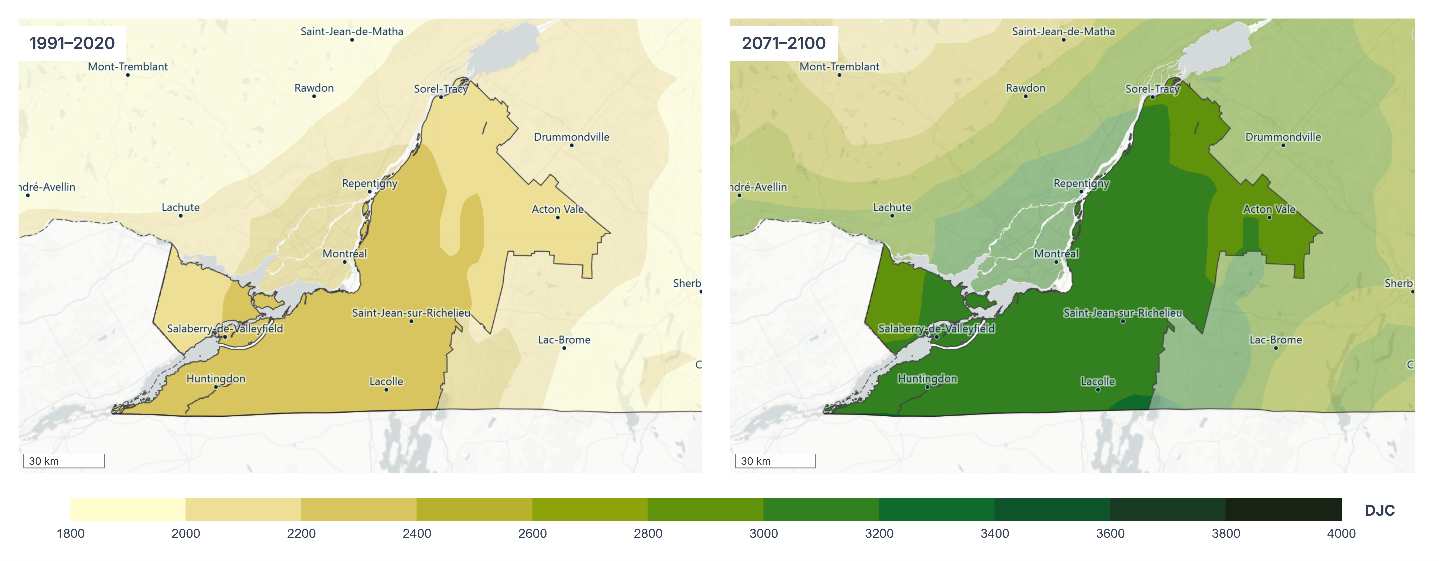
Figure 2: Comparaison des degrés-jour de croissance annuelle de base 5⁰C en Montérégie entre le climat actuel (1991-2020) à gauche et le climat futur (2071-2100) à droite, selon le scénario à émissions élevées (SSP7-7.0), 50e centile. (Portraits climatiques, Ouranos).
This could benefit the production of crops like corn and soybeans, and certain forage species. To take advantage of this potential increase in yields for certain crops, practices must be adapted to the new conditions. The date or number of annual harvests could be changed, or varieties better suited to the future climate could be used.
However, crops that grow in cooler regions (canola, barley, wheat, etc.) would be penalized by these changes.
Several regions that are currently too cold for the production of certain crops could see their potential develop. There will be a possible expansion of certain crops northward, such as corn, soybeans and apples, if the soil quality and topography allow it. By 2050, viticulture could also expand to regions with new viticultural potential, such as southern Outaouais and the St. Lawrence Valley.
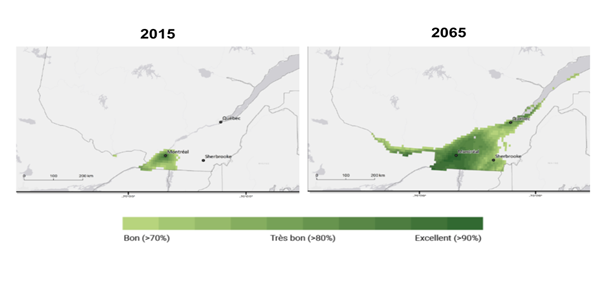
Figure 3: Progression of the climate potential for viticulture in the St. Lawrence Valley up to 2065 under a combination of the RCP 4.5 and 8.5 scenarios. Favourable conditions for viticulture: over 1000 degree-days, 156 consecutive days without frost, minimum winter temperatures above -30°C and less than 20 days with a temperature below -22°C. (Source: Alberti-Dufort et al., 2022; Original source: Roy et al., 2017)
It is essential to take measures to protect soil quality. Land could eventually be converted to annual crops in colder regions where perennial crops still occupy significant areas. Protecting soil quality is especially important in regions with clay soils, such in the Laurentians and Témiscamingue and around Lac-Saint-Jean, and in areas with sandy soil like northern Lac-Saint-Jean and Abitibi. In these environments, the soil organic matter content could decrease further due to climate change and changes in farming practices.
Research Project | Changes in Spatially Distributed Soil Health Indicators Under the Influence of Climate Change in Quebec and Ontario
This project, intended for producers and stakeholders in the agricultural sector, provides ways to understand the impacts of climate change on land use, soil health and the soil’s vulnerability to degradation.
Despite certain advantages for crop growth that a warmer climate might offer, negative impacts are also anticipated, which could partially offset these gains. Farmers have always had to deal with crop pests and other threats such as diseases or weeds. Changes in the climate could have a major impact on the abundance and range of such pests.
In this context, a number of species that are naturally present in Quebec may proliferate even more, in addition to being joined by exotic invasive species as the latter expand their ranges northward. This could increase the risk of crop damage and therefore influence the use of pesticides, which could have repercussions on both the quality of the environment and human health.
Research project | Adaptation of Phytosanitary Measures for Pests and Diseases of Fruit Crops in Regard to Climate Change Impacts
The knowledge resulting from this project will enable the development or revision of planning and action tools for decision makers in order to assist the crop protection sector to adapt to climate change.
Research project | Impact of Climate Change and Adaptation Measures on Present and Potential Future Field Crop Pests in Quebec
The knowledge gained from this project will allow the development or revision of planning and action tools for decision makers in order to promote the adaptation of the crop protection sector to climate change.
Damaging weather events
Climate change will also result in an increase in heat waves, freeze-thaw cycles in winter, and extreme precipitation events, as well as a worsening of drought episodes.
Due to an increase in both the frequency and the intensity of heat waves, climate change can affect crops as well as livestock. Animals can suffer physical stress due to the heat, reducing their productivity, reproduction and well-being. The risk is reduced when livestock buildings are equipped with cooling systems, such as ventilation or misting, provided that they remain effective under these new conditions.
The intensification of heat waves can also increase the health risks for agricultural workers, who mainly do their work outdoors. Health problems such as heatstroke, dehydration and cardiovascular disorders related to difficult working conditions can occur.
The increase in freeze-thaw events during the winter is another factor that can weaken productivity. When there is no snow to protects plants’ roots, they are more vulnerable to freezing, which increases their mortality. This particularly affects certain perennial forage crops that are often used as livestock feed.
Research project | Choice of Forage Grass and Mitigation of Heat Stress for Cows on Quebec Dairy Farms in the Context of Climate Change
The results obtained make it possible to provide dairy farm managers with concrete recommendations for choosing forage mixes adapted to current and future climate conditions and solutions to reduce the risk of heat stress in barns during hot summer weather.
Climate projections indicate an increase in both extreme rainfall events and periods of low rainfall associated with drought.
On one hand, heavy rainfall can damage crops and fields. It can cause soil erosion and surface runoff and promote the transfer of nutrients and pesticides to nearby bodies of water.
On the other hand, the increase in summer temperatures will lead to higher evapotranspiration, which will accentuate the water needs of crops in open fields or under cover. The rise in temperatures will also affect livestock farms and increase their water needs, not only for watering animals, but for temperature control in buildings as well.
Water needs in the agricultural sector will likely increase due to climate change and contribute locally to increased pressure on water resources in areas where agricultural withdrawals are significant.
Research Project | Participative Research on Sustainable Alternatives for Water Management in Agricultural Areas in the Context of Climate Change
The RADEAU 1 and 2 projects have provided the government and regional decision-makers with information on water management. They enhanced and structured the existing data used to categorize the water balance of several regions in current and future climates. They also proposed recommendations for the development of intervention strategies to mitigate or avoid water use conflicts in agriculture in Quebec.
Research project | Maple Syrup Production and Climate Change: Identifying Maple Syrup Producers’ Concerns and Providing Them With the Best Information to Promote and Support Adaptation
The aim of this project is to produce useful information to promote the adaptation of the maple syrup industry, in a form that is appropriate for its users, i.e. maple syrup producers and the organizations that represent them. It also aims to better understand their perceptions and concerns regarding the impacts of climate change on their practices, to explore possible adaptation solutions, and to assess whether these perceptions vary across regions and provinces.
International events affecting Quebec’s agricultural sector
The impacts of climate change affecting agricultural regions elsewhere in the world can have repercussions on global agricultural markets. Quebec may be exposed to this due to its exports or imports of agri-food products. For example, an increase in droughts, flooding, or even forest fires in the countries from which some imported foods consumed in Quebec originate can affect their availability and cost in grocery stores. It is often the most disadvantaged populations who are most affected.
Research project | Lait-é : Toward a Climate-Resilient Dairy Industry
This project aims to strengthen the climate resilience of Quebec’s dairy industry by developing innovative strategies for milk quality and animal welfare, both in the barn and at the processing level.
Research project: Exploring the Health and Safety Risks Associated with Climate Change and the Most Promising Prevention Methods for Quebec Food Processing Company Employees
This project aims to develop knowledge on the risks that climate change poses to the health and safety food processing industry workers in Quebec.


Last update of the page: January 2026.
